
Scoot N Go
Enhancing Campus Mobility & Sustainability
Scoot N Go was a team project for the Contextual Inquiry course created by Sehar Alimohammed, Noor Al Mallallah, and Zach LeMunyon under the guidance of Dr. Rupa Misra.

Overview
Scoot N Go is a conceptual redesign of the typical campus e-scooter experience, a next-generation e-scooter app designed to improve transportation for students, faculty, and visitors at Rutgers University. Built as part of a contextual-inquiry course project by a three-person team, the app reimagines campus commuting with user-centered design, clear navigation, safety, and sustainability in mind.
Problem Statement
Students using the existing scooter rental system (via the VEO app) reported multiple pain points:
Difficulty finding scooters or reliable parking spots on campus
GPS inaccuracies and inconsistent scooter availability
Confusing sign-up / payment flows and unclear ride-ending process
Lack of safety information (e.g., weather, campus hazards) and no way to report issues or provide feedback
These issues resulted in friction, anxiety, and low user satisfaction, undermining the convenience value that scooter-sharing is supposed to offer.
User Research
We conducted contextual interviews and on-campus observations to capture real behaviors and issues.
Participants: 4 Rutgers students with varied backgrounds and scooter-experience levels.
Methods: phenomenological research approach, semi-structured interviews, and direct observation during typical campus commutes.
Key Insights:
Frequent GPS or mapping glitches led to wasted time or failed rides
Payment and ride-ending glitches caused stress, overcharges, or cancellations
Users lacked trust in the current system due to inconsistent scooter maintenance and unclear safety/parking zones
Absence of support/feedback channels made users feel stuck when issues arose
From affinity mapping and clustering, we distilled core themes: Navigation, Functionality, Accessibility, Safety, and Trust.
Solution
Scoot N Go integrates these needs into a single, user-friendly app:
Smart GPS Navigation: real-time routes and hazard alerts.
Multiple Payment Options: Apple Pay, Google Pay, Venmo, PayPal, and credit/debit cards.
Personalized Profiles: saved routes, preferences, and payment info.
Safety Alerts: live traffic and weather notifications.
Sustainability Dashboard: track carbon emissions saved per ride.
Design Process & Ideation
Based on those themes, we applied the “7 Cool Concepts” framework (from Contextual Design – Defining Customer‑Centered Systems by Holtzblatt & Beyer) to inform our design strategy:
Accomplishment: Simplify start-to-ride flow – unlock scooter with one tap, streamlined payment, and ride end.
Connection: Enable community-based features (shared rides, ride buddies, campus groups) for social safety and sustainability.
Identity: Reflect eco-consciousness: user profile includes environmental impact, ride history, saved preferences.
Sensation: Clean UI, intuitive layout, subtle animations/feedback for unlocking, ride start/end, and alerts.
Direct into Action: Minimal onboarding friction – quick registration, optional sign-in, clear prompts.
Hassle Factor: Provide support and feedback options – instant report button for broken scooters, help center, ride history.
Learning Delta: Onboarding tutorial + contextual tooltips for first-time users; progressive disclosure of advanced features (e.g., sustainability dashboard, saved routes).
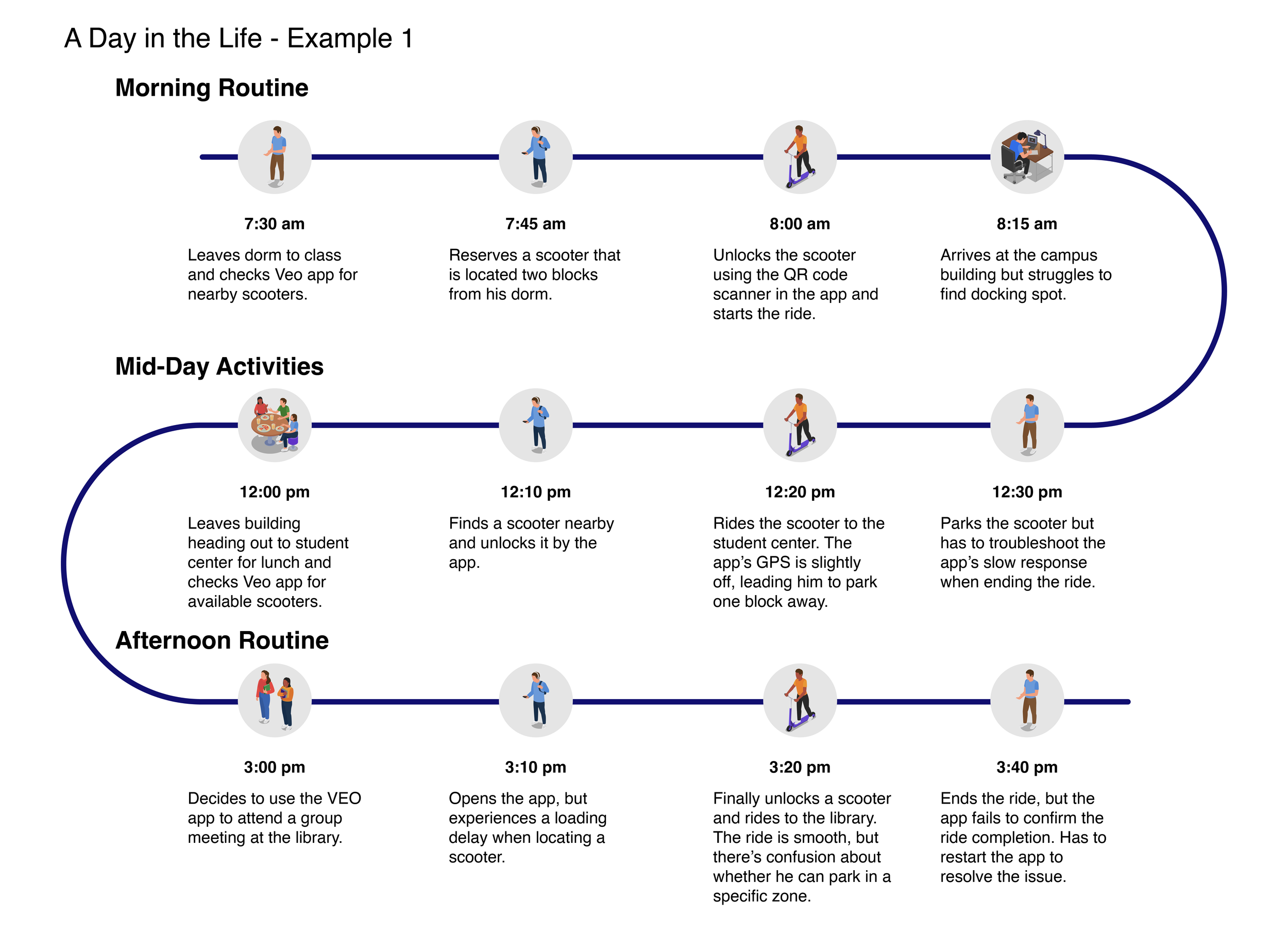
Day-in-the-Life Model
Name: Alex (Undergraduate Student)
Age: 21
Major: Business Administration
Devices Used: Smartphone (iOS)
Final Design & Prototype
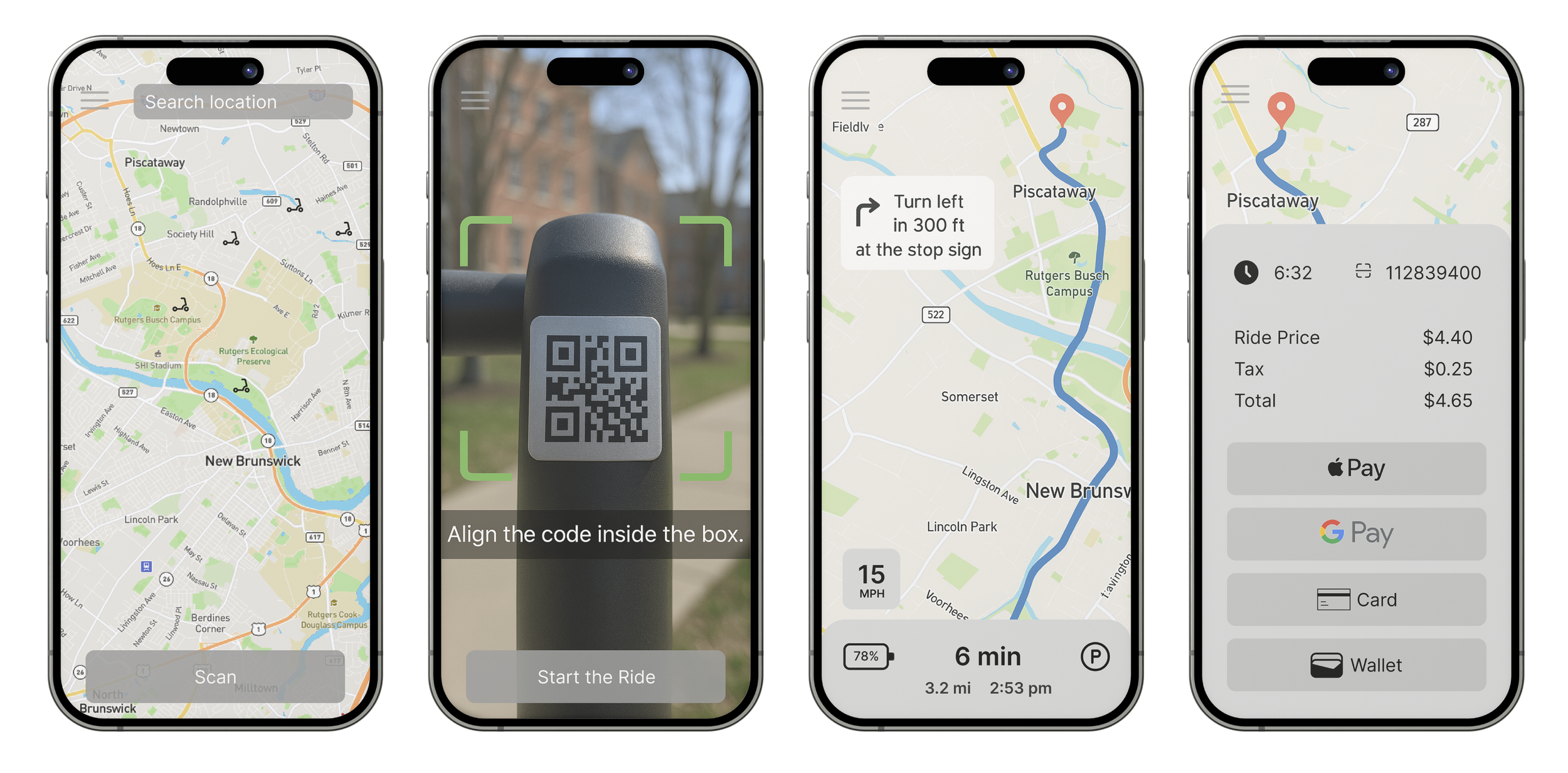
Map / Home Screen: shows real-time locations of available scooters, battery level, and parking zones. Includes search bar + filter (availability, distance, battery).
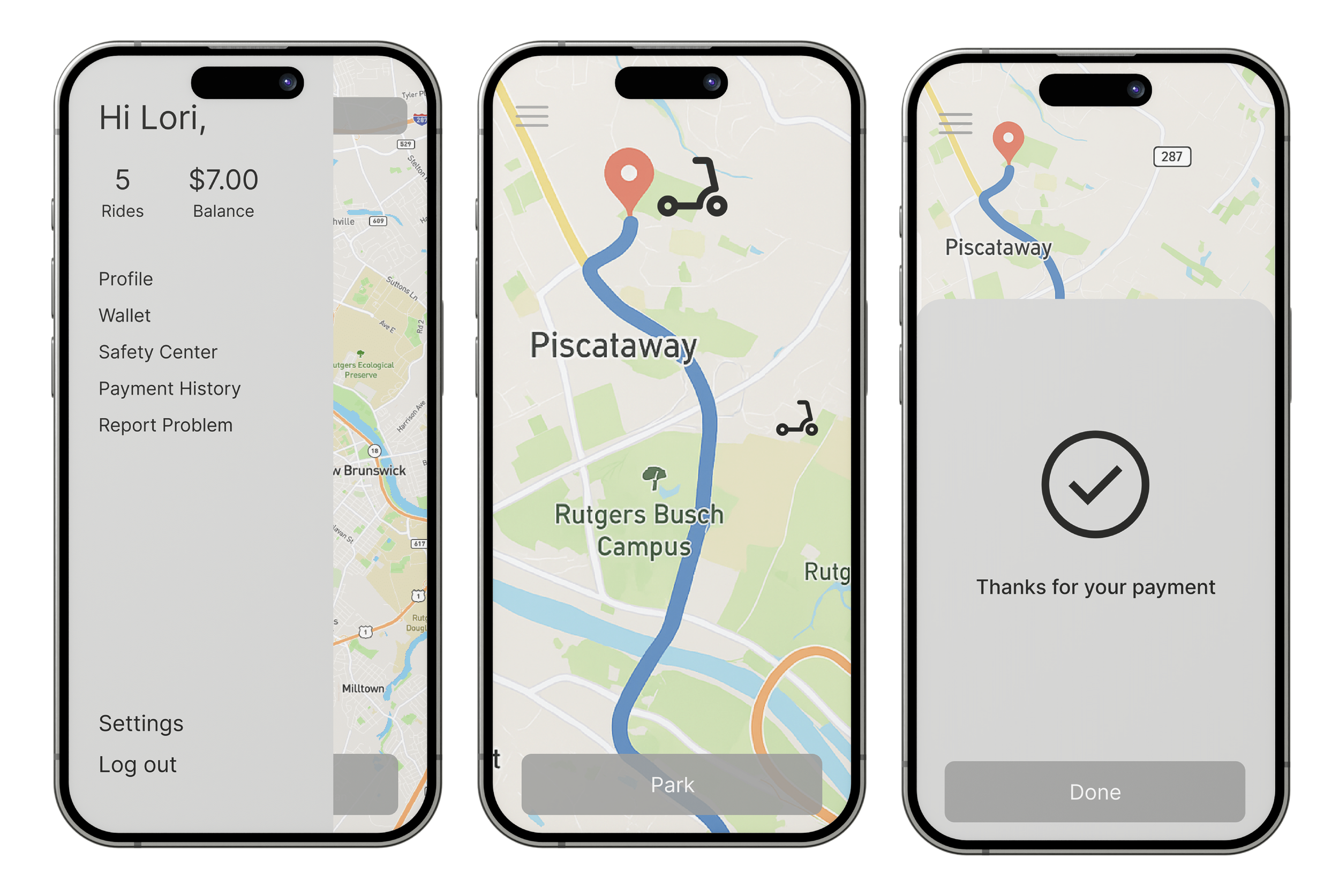
Ride Flow: “Scan to unlock” → ride tracking (time, speed, battery, route) → ride end & summary screen (time, cost, distance, carbon saved)
Profile & Dashboard: user ride history, favorite routes, payment methods, sustainability stats (e.g., CO₂ saved, miles ridden)
Support & Feedback: in-app help center, report issue button, feedback form, emergency contact option
Safety Alerts: push notifications for campus events, weather hazards, restricted zones – proactively warn users
Usability Testing & Iteration
We conducted a usability test with 4 participants. Feedback included:
Positive: Users appreciated simplicity, clarity of ride flow, and the sustainability dashboard.
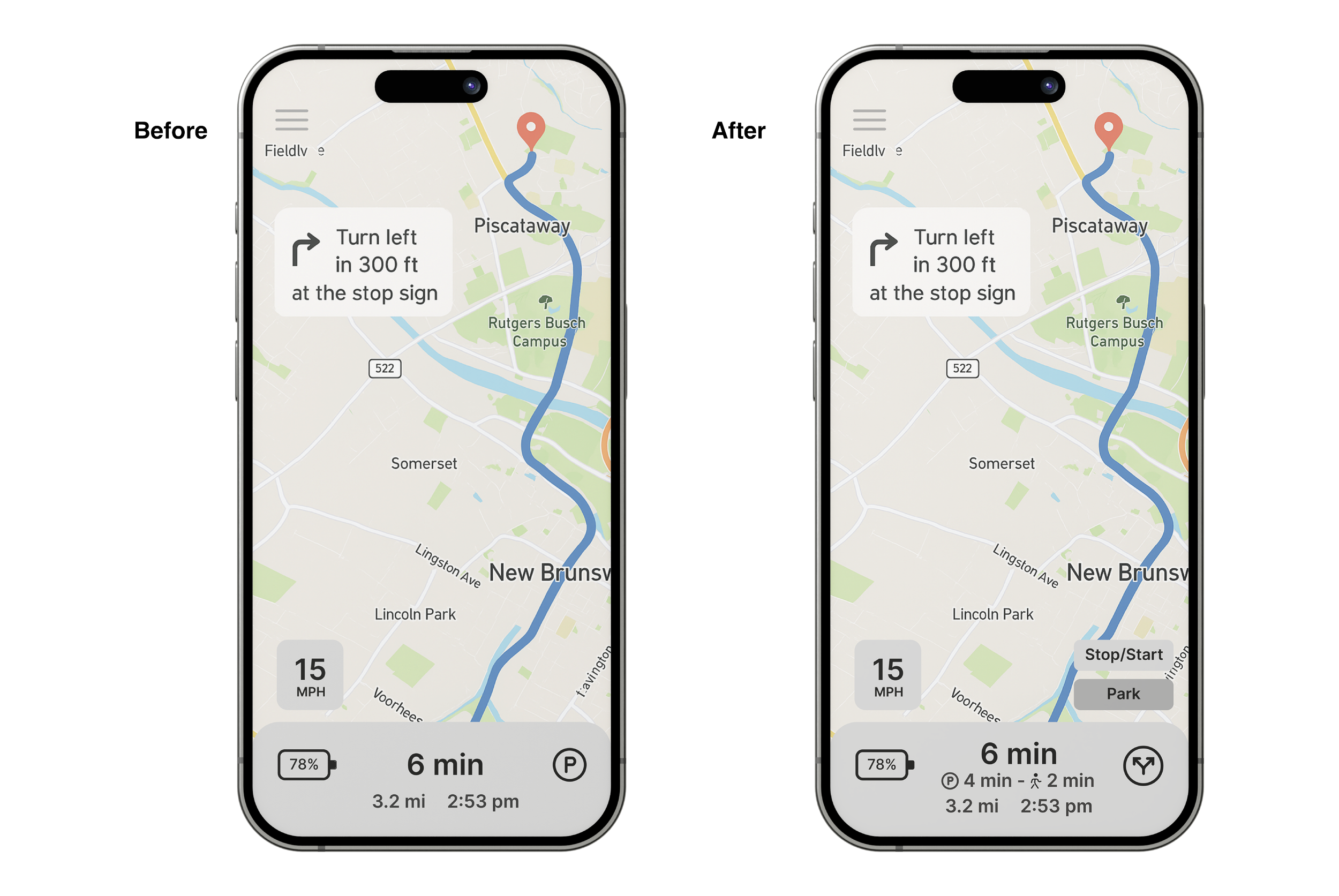
Key suggestions: wanted clearer destination arrival indication (walking vs riding), estimated travel time before unlocking, and stronger security/verification for ride start.
Post-Test Improvements
Added estimated time/distance preview before unlocking
Enhanced destination screen to indicate arrival status and walking vs ride estimates
Added optional user verification (e.g., confirm phone or student ID) to improve trust
Results & Impact (What This Case Study Shows)
Though this was an academic project and not a live product, the design exercise demonstrates:
Ability to conduct user research, draw real insights, and translate them into design requirements
Strength in designing a full end-to-end user journey: onboarding → ride flow → post-ride feedback/impact
Thoughtful inclusion of safety, sustainability, and user trust — criteria often overlooked in scooter apps
Clear documentation of process and design thinking, which increases credibility as a designer
Learnings
Contextual inquiry + direct observation yields stronger, more realistic user pain points than surveys alone
Importance of building trust and transparency when designing mobility / shared-transportation solutions
The value of iterative prototyping + user feedback — even small interface tweaks (timing, confirmations) significantly change perceived user confidence
Next Steps
Expand testing to more users, including first-time riders, and track long-term usage patterns
Add scooter maintenance/reporting features (photos, status, geo-tagging)
Integrate push-notifications for campus-wide alerts (weather, events, maintenance)
Collaborate with campus/scooter providers for real data and pilot implementation